
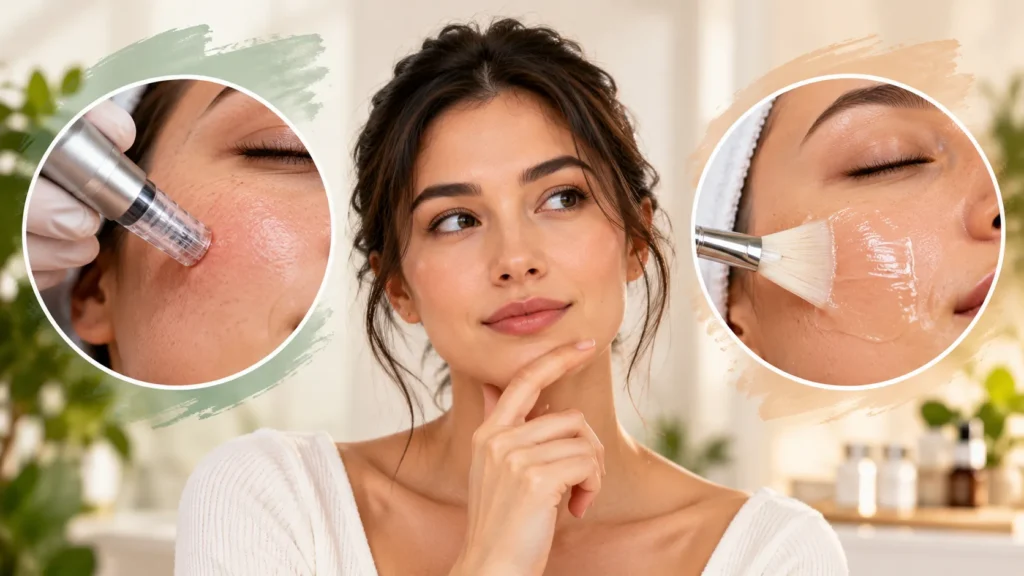
You look in the mirror under bright light and notice small dents on your cheeks, a dull patch on your forehead and a few dark marks that won’t fade. You’re looking for a fix, and two treatments keep coming up: microneedling and chemical peels.
Both are popular skin rejuvenation treatments, but they work in different ways. Here’s a plain explanation of each, so you can have a more useful conversation with your practitioner.
What does microneedling do?
Microneedling uses a device with very fine needles to make tiny, controlled pricks in the skin. That sounds harsh, but the punctures are very small. The skin responds by repairing itself, and that repair process helps stimulate new collagen. Collagen is the protein that keeps skin firm and smooth.
Because it works gradually, you won’t see the full effect after one session. Most people have a course of treatments.
What does a chemical peel do?
A chemical peel applies a solution to the skin’s surface. It loosens the outer layer of dead skin so it can shed. The skin underneath is often brighter and smoother, which is why peels are often used for dullness and dark marks.
Peels vary in strength. A light peel may cause a little flaking for a few days. A stronger peel can cause peeling for longer, so ask your practitioner what to expect from the strength they recommend.
Marks or scars: the difference that matters
Before you choose a treatment, work out whether you have a mark or a scar.
A mark is a flat area of colour, which can be red, pink or brown. It’s left behind after a spot has healed.
A scar changes the shape of the skin. It looks like a dent or a pit.
As a rough guide, peels are used mainly for colour changes, and microneedling is used mainly for texture and shape. To check at home, run your finger over the area. If you can feel a dip, you may have a scar. If the area is flat, it’s more likely a mark.
Which treatment for which concern?
Indented acne scars: Microneedling is usually the first choice, because it aims to stimulate collagen under the dent. Chemical peels are generally less effective for deeper scars.
Red or brown marks after spots: A peel can help with these by removing the discoloured top layer. Results depend on the mark and the peel strength.
Rough texture and large pores: Microneedling is typically used for this.
Fine lines: Microneedling is typically used for this too, because it stimulates collagen.
Dull skin: A peel can give a quick glow, though the effect is usually temporary and depends on the peel.
Uneven tone or sun spots: Peels are often used first for this. Microneedling may help too, but it usually takes longer.
These are general guidelines. A skilled practitioner should look at your skin before you decide.
Downtime and aftercare
Downtime is the main concern for most people.
After microneedling, the skin often looks red, a bit like a mild sunburn. This usually settles within a day or two.
After a peel, skin may feel tight or sensitive and may flake. How long this lasts depends on the strength of the peel.
Most people have a course of treatments rather than one visit. Both treatments make skin more sensitive to the sun, so use sunscreen every day, including in winter.
Skin tone matters
If you have darker skin, take extra care. Irritation can trigger dark patches, known as post-inflammatory hyperpigmentation, and an aggressive peel can cause this. Ask your practitioner:
Have you treated skin like mine before?
What peel strength or needle depth would you start with?
If you have melasma, get professional advice first, because heat and irritation can make it worse.
Can you have both?
Some clinics offer both treatments, but usually not on the same day. Your practitioner will plan the order and the gap between sessions. Don’t combine treatments on your own, especially if your skin is already irritated.
Who should check with their practitioner first?
Tell your practitioner before treatment if you:
Have active breakouts or inflamed spots
Are pregnant or breastfeeding
Have taken isotretinoin recently
Use retinoids or other strong acne treatments
Have a history of keloid scarring
Have an active skin infection or cold sore near the treatment area
Some of these may mean waiting before treatment.
Common mistakes to avoid
Choosing by trend rather than by concern. Start with what you want to fix.
Using a home roller as a shortcut. Home devices are different from professional equipment and can damage the skin.
Treating active breakouts. Wait until the skin has calmed down.
Skipping sunscreen. Freshly treated skin is more prone to marks.
Expecting one visit to fix everything. Real change takes a course and patience.
Expecting deep scars to disappear. Treatment can soften them, but it rarely removes them completely.
Microneedling and peels at Tama Aesthetics
Tama Aesthetics is at 154 Stafford Road, Wallington, SM6 9BS. We offer Microneedling from £150 per session. The clinic also offers a bioactive algae peel from £130 per session. You can book a free consultation online or call 07898 169870 or 020 8058 5809.
Prices may change, so check the current prices with the clinic before you book.
When is the best time to start?
Autumn and winter are often a good time to start, because the sun is generally weaker. October is a sensible time to begin, so you could complete a course by spring.
FAQs
Is microneedling better than a chemical peel for acne scars?
For dents and pits, microneedling is usually the better choice. For flat red or brown marks, a peel can help. Some people need both at different stages.
Does microneedling hurt?
Most clinics use a numbing cream first. You’ll feel pressure and a scratching sensation, which most people find tolerable.
Can I have microneedling and a chemical peel in the same week?
It’s generally best not to. Ask your practitioner how long to wait between treatments.
Which works better for uneven skin tone?
Peels are often used first for dark spots and patchy colour. If you have melasma, get professional advice first.